Thursday, May 16, 2013

Tenements of Wonder: Andrew Atchison and Stephen Benwell


With its striking Aubrey Beardsley cover, the first volume of The Yellow Book (1894) presented a cross-section of recent English literary and artistic activity. It also hammered a stake through the heart of the heteronormative world due to the appearance within its pages of an article by the previously unpublished 22-years old Max Beerbohm. With “A Defence of Cosmetics” (later republished as “The Pervasion of Rouge”), Beerbohm precociously combined a mocking pastiche of his mentor, Oscar Wilde, with a deadly serious manifesto of the aesthetics of artifice derived directly from Wilde himself. The opening paragraph begins, “Nay, but it is powerless to protest. Artifice must queen it once more in the town…”. Not surprisingly, the windows of The Yellow Book ‘s publisher were stoned by a mob shortly after it was reported (erroneously) that Wilde was seen carrying a copy of it at his arrest (1895). In a sense, yellow was just one of the many colours of this rainbow-hued publication, so redolent was it of a contemporary queer subculture. The Yellow Book didn’t long survive Wilde’s trials and imprisonment, ceasing publication in 1897.

In his own manifesto, How to be Gay (2012), David M Halperin claims artifice as a key element in gay subjectivity, in what it feels like to be homosexual. Halperin locates the emergence of this quality in early childhood, a consequence of innocent queers being thrust into a world not made for them. This gay “sixth sense” allows for a prescient understanding of gender performativity and consequentially of all forms of social role-playing, regardless of how natural they seem in a heteronormative world. Halperin argues that aesthetics, the codifying of artifice, is a special (and stereotypical) preserve of gay men, providing a protective buffer to the compulsory straightness that surrounds and sometimes threatens. It constitutes a key characteristic of gay culture (along with camp), but not one that necessarily defines all gay men, or that all gay men take pride in. 

Emily Dickinson’s poem, “Some we see no more, Tenements of Wonder” (1871), treats the image of a dazzling storeyed building metaphorically as a casement for minds and personalities of enduring significance, some now lost to the poet in death. I’ve borrowed this image as shorthand for gay subjectivity, especially its aesthetic tendency, shining forth in blinding colours and striking architectural details. In presenting the very different work of two gay artists, Stephen Benwell and Andrew Atchison, I’ve suggested what some of these qualities might be and what they might look like.

The six-coloured rainbow flag (originally eight-coloured) designed by San Francisco artist Gilbert Baker in 1978 is used universally as a symbol of GLBT pride. In much of his recent work, Andrew Atchison appropriates its colours to tease out other resonances: scientific, Biblical, cinematic, and art historical. Building on his sculptural practice, Atchison has sought ways to animate the rainbow colours in spatial settings. His temporary public art project Commune (2012) was initially designed as a hanging circle of multi-coloured ropes to be installed in a busy causeway at Southern Cross Station. When this site became unsuitable for various reasons, the project was shifted to a public park in Docklands where the original format proved less practical technically and aesthetically. Atchison re-thought the work as a monumental portal decorated with coloured ropes, a queer triumphal arch in the midst of the dullness of that blighted development. Before “Docklands”, the docks themselves had been the site of the massive ALSO Foundation warehouse parties of the 1980s and 90s, the acme of gay culture in those years. For me, Commune memorialised those fabulous, ephemeral events, and also evoked the values of the once coherent gay community that had participated in them. Lost to illness and ageing and the dynamics of social change, that community has since made way for a multitude of subcultures. Although Atchison’s work is also now dismantled, Commune survives in the memories of those who experienced it, and in shards of documentation. Wondrousness moves on…

Halperin signals a further attribute of gay subjectivity that is closely allied to the aesthetic: the obsessive collector. The rigorous attempt to master categories of taste by either acquisition of things or encyclopaedic knowledge about them is a defining characteristic of many gay men. Again, it signals a protest against the normal world, a solitary act of world-making by homos in response to their experience of wrong fit. Stephen Benwell is well versed in the world of the collector, not only by making work that is collectable and collected, but by making works conceived as collections. The twelve sets of Collections (2009), originally shown at Shepparton Art Gallery, mimic museum displays of ancient objects with their tight organisation of heterogeneous pieces -- a fragment of a supposed masterpiece sitting next to an egg cup. Benwell plays with scales of time and context. His classical heads and torsos sprout hair and have rosy lips, their proportions more akin to contemporary gym culture than Athenian gymnasia. The particular set of Collections selected for Greenwood Street Project consists of a multitude of diminutive vessels that resemble the cosmetic and ointment jars seen in many study collections of ancient cultures. Brightly coloured, they appear still to be in use, perhaps as vessels to mix the opaque pigments seen in Benwell’s recent paintings. With their rich chalky colours resembling make-up, the series of painted portraits entitled Trojan Woman make this connection almost literal. But like the Collections with their pop sensibilities, these portraits (derived from a Piranesi engraving of a classical sculpture) are no mere copies. With his gentle cubist facture, Benwell lends them an updated fragmentation different to that posed by the ravages of time.

A famous dandy along classic Wildean lines, Max Beerbohm maintained rigorous aesthetic standards throughout his long life. Although tending towards asexuality and eventually marrying, he was not gay. He can, nonetheless, be coded as queer. Certainly his writings from the 1890s, the so-called Naughty Nineties, speak loudly of this. In a further Wildean spoof, A Peep into the Past (1894), Beerbohm knowingly noted the presence at Wilde’s Tite Street address of “the constant stream of page-boys, which so startles the neighbourhood”. His essay on the history of cosmetics, with its championing of artifice over nature, places him squarely beneath the rainbow arch spanning the gay pantheon, which also now includes the work of Andrew Atchison and Stephen Benwell.


Michael Graf
Melbourne May 2013

Thursday, January 31, 2013

Atlas for the Devil- Installation View

Elisabeth Vary
“Untitled’ 2009
42 x 36 x 3.5 cm
Oil colour on cardboard

Bin Dixon-Ward
“Tapered Cubes Ring #2” 2012
3 D printed nylon and ink
9 x 5 x 4 cm variable 
Courtesy of the artist


Bin Dixon-Ward
“Framework Neck piece (small)” 2012
3 D printed nylon and ink
Dimensions variable 
Naoto Fukasawa
“TV Murrine Paper weight”
Murrine in flashed Murano glass, hand-ground 
Limited numbered edition
Manufacturer: B&B Italia
10 x 8.5 x h 6.5 cm.


Rosslynd Piggott
“Two Mirrors - Night Collapsing” 1999-2000 
80 x 120 cm Two Panels
Palladium on linen & silver leaf , pearls , nylon thread on linen. 


Installation View


Wolfram Ullrich
“Untitled [Gelb/ Citron]” 2000-2001
25 x 50 x 5.2 cm
Acrylic on steel.

Installation View

Installation View

Installation View

Sunday, January 27, 2013

Atlas for the Devil


In a world of compulsive shallowness it can be enlightening to discover the surface is being pursued with some seriousness. This exhibition links five objects: three by the tool and two by the substrate.  All of these objects provide a connection and disjunction with the support for their married surfaces.

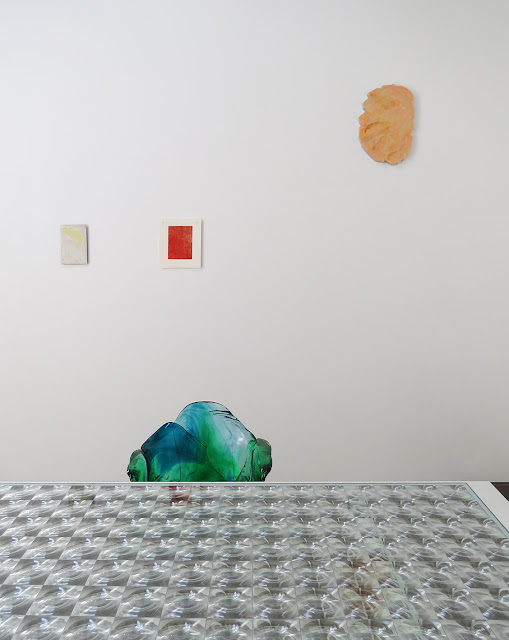
A work by Elisabeth Vary has a glossy intoxication in its translucency but the mystery deepens with two punctures and an overt profile to the object that suggests flatness and depth at once. 

A diminutive object, paradoxically, with the most physical mass, is a murrine paperweight in flashed Murano glass, hand-ground, that when set on paper it becomes a magnifying glass that enlarges words and pictures. This TV Murrine Paperweight, by Naoto Fukasawa, for B&B Italia is the result of grinding and polishing the surface to increase its internal visual depth also bound in a fused surface that increases its immutability.  It is dense & functional while being sensuous & meaningful in its weight.

Bin Dixon-Ward has been developing jewellery using 3D printing process. This technical approach allows the creation of extremely complex forms and linkages previously unthinkable. The technology used in the form making and the objects surface and saturated colour alludes to a mechanical production but the objects are hand finished and coloured reengaging the artist’s physical touch in the surface.

Inversely the work by Rosslynd Piggott carries on its surface, the tools of its making. In the form of pearls they are the devices for its figuration or possibly disfiguration. They float on the platinum foil surface, at rest, ignoring their habit of menace. Pearls embody both mass and surface simultaneously, built from calcified layers triggered by an irritant, inspiring their existence.

More obliquely we have Wolfram Ullrich’s work. This piece is a steel construction that presses from the wall, dimensional and sculptural. It twists in space to deny the viewer the hope of orthogonal relief. Conflated, the prime face is painted, matt in finish and in a stinging citron colour that provides an edge and defines the floating form. The beguiling austerity of the surface is in league with its support, to continue to extend the reflex of this perspectival illusion.

The various frictions between face, volume, illusion and mass bring to mind Wolfgang Pauli’s rumination: “God made the bulk; surfaces were invented by the devil.” At the time, Pauli was discussing the way the atoms hover above and below the surface of a material, inferring complexity at the outer edge of materials, portraying unique visual qualities yet complete integrity with the mass. There is something deeper than the surface of his aphorism.  It could ask : What underpins us? What supports our ambition? Is the image applied or integral? Is it held or withheld?

Atlas for the Devil
Greenwood Street Project
Begins February 2013
Supervised By Donald Holt


Monday, January 14, 2013

JANUARY 2013

installation view
Tomislav Nikolic
MUSE, 2005
Reinstalled at GSP during January 2013
10 framed parts:
acrylic and marble dust on paper
55 x 55 cm each


Tuesday, September 11, 2012

FOAM Work by Michael Graf : Installation Images

Detail-
Come down fr-
2010 – 2012
Oil paint on canvas board
12 panels, 35.5 x 45.7 

Come down fr-
2010 – 2012
Oil paint on canvas board
12 panels, 35.5 x 45.7 


GeneièeÈtempodirientrare.Pelléas,mostralastradaaMélisande.Deoandare,aederepiccoloniold(esce)PelléasNonsiedepiùnullasulmare..
Mélisandeedoaltreluci.PelléasSonglialtriariSentiteilmare?Èilentoches’ala…Scendiamoperdiva.oltetedarmilamano?Mélisandeedete,edete,olemanipienediioriPelléasisosterròcolbraccio,ilcamminoèscoscesco,edèmoltobuio.orsepartodomani…
MélisandeOh!…Perchépartite?(escono)AttoIIScenaIUnaontonanelparco.EntranoPelléaseMélisandeNonsapetedove‘oportata?engospessoasedermiuaersomeodì,uardoètroppocaldoneigiardini.Sisoffocanceall’ombradeglialberi.MélisandeOh!L’acuaèciara…PelléasÈunaecchiaontanaabbondonata.Pareosseunaontanamiracolosa,apriaglioccideicieci,laciamanoancora<>.

2011 – 2012
Oil paint on canvas board
15 panels, either 35.5 x 45.7 or 45.7 x 35.5


Untitled
2010 – 2012
Oil paint on canvas board
15 panels, either 35.5 x 45.7 or 45.7 x 35.5

Detail-
Untitled
2010 – 2012
Oil paint on canvas board
15 panels, either 35.5 x 45.7 or 45.7 x 35.5

Detail-
GeneièeÈtempodirientrare.Pelléas,mostralastradaaMélisande.Deoandare,aederepiccoloniold(esce)PelléasNonsiedepiùnullasulmare..
Mélisandeedoaltreluci.PelléasSonglialtriariSentiteilmare?Èilentoches’ala…Scendiamoperdiva.oltetedarmilamano?Mélisandeedete,edete,olemanipienediioriPelléasisosterròcolbraccio,ilcamminoèscoscesco,edèmoltobuio.orsepartodomani…
MélisandeOh!…Perchépartite?(escono)AttoIIScenaIUnaontonanelparco.EntranoPelléaseMélisandeNonsapetedove‘oportata?engospessoasedermiuaersomeodì,uardoètroppocaldoneigiardini.Sisoffocanceall’ombradeglialberi.MélisandeOh!L’acuaèciara…PelléasÈunaecchiaontanaabbondonata.Pareosseunaontanamiracolosa,apriaglioccideicieci,laciamanoancora<>.
2011 – 2012

Oil paint on canvas board
15 panels, either 35.5 x 45.7 or 45.7 x 35.5